


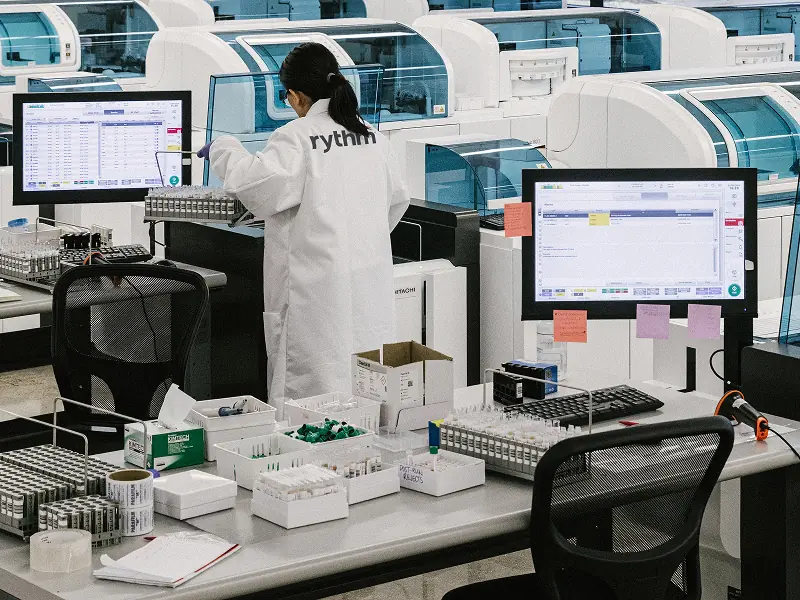
Stability, Shipping Logistics, and the Science Behind Fast, Reliable Results
When you collect a sample using Rythm’s at-home kit, a large amount of biochemical and logistical engineering is activated behind the scenes to ensure your results are accurate, stable, and delivered in less than seven days. What most people never see is that the pre-analytical phase, meaning everything that happens before your blood reaches the analyzer, is the single most important determinant of laboratory reliability.
This article explains how your sample is stabilized, how shipping and temperature exposure are managed across clinical diagnostics, why chain-of-custody matters, and under what conditions a specimen may be rejected. The work that happens between collection and analysis is invisible to most people, but it forms the foundation of laboratory accuracy.
Sample Stability
The Science of Keeping Blood Analytes Intact
Once blood leaves the body, it begins to undergo predictable biochemical changes. Enzymatic reactions continue, cells consume glucose, gases diffuse, metabolites shift, proteins degrade, and under unfavorable conditions hemolysis or clot formation can occur. None of this is unique to at-home testing. These processes occur in every clinical laboratory sample, regardless of where it is collected.
Rythm uses lithium heparin microtubes, which inhibit coagulation rapidly without strong chelation of calcium or magnesium. This anticoagulant choice reduces clot formation during transport, stabilizes many chemistry analytes that are sensitive to delayed processing, and minimizes additive-related analytical interference.
Most importantly, the Rythm biomarker panel was intentionally designed around analytes with validated stability windows that extend up to four days under ambient conditions. This includes stability without immediate refrigeration or centrifugation. This design supports the realities of overnight shipping and protects against minor transit delays.
Many traditional laboratories and clinics also ship specimens, often across long distances, and this practice is standard throughout clinical diagnostics. With appropriate anticoagulation, packaging, and time controls, shipping blood samples is normal, expected, and well validated.
Expert depth
Clinical laboratory standards emphasize that analyte stability depends on time, temperature, matrix, and anticoagulant. Panels intended for delayed analysis must be intentionally selected and validated within these constraints, rather than assuming immediate processing.
How Traditional Clinical Laboratories Transport Samples
Many people assume that blood collected at a walk-in laboratory is processed on site. In reality, very few clinical laboratories perform final analysis in the same building where specimens are drawn.
After venipuncture, specimens are placed into temperature-buffered containers, leave the collection site in scheduled courier pickups, move through regional distribution hubs, and often travel overnight. Final analysis may occur twelve to twenty-four hours after collection, or longer in some systems.
This pipeline is fundamentally similar to at-home testing workflows. The primary difference is where the sample begins its journey. In one case, it originates from a collection center. In the other, it originates from your home.
All modern clinical diagnostics depend on safe, rapid transport. Shipping blood is standard practice across the industry. The key variables are anticoagulation, temperature control, and time. These variables are intentionally integrated into the Rythm system.
Full Chain-of-Custody
Tracking Your Sample at Every Stage
One of the distinguishing features of the Rythm system is its closed internal chain-of-custody. Because Rythm controls the operational pathway from warehouse to clinical laboratory, your sample remains under continuous oversight.
Each kit is scanned when it leaves the warehouse, delivery is confirmed, shipping events are tracked when the collected sample enters the courier network, and receipt is verified when the sample arrives at the laboratory. All transitions are timestamped and monitored.
Clients are kept informed throughout this process. You receive updates when the kit ships, when it arrives, when your collected sample is in transit back to the laboratory, when it is received, and when results are ready. This transparency allows you to know where your specimen is and what is happening to it at every stage.
This level of closed-loop visibility is uncommon in traditional laboratory systems, which often involve third-party collection centers, separate courier services, and independent laboratories. Maintaining internal chain-of-custody allows rapid identification of delays and ensures samples arrive within validated stability windows.
Expert depth
Chain-of-custody is a core quality concept in regulated laboratories. Timestamped transitions enable correlation between transit time and analytical performance, allowing continuous quality monitoring and process improvement.
Temperature Sensitivity
Why All Blood Samples Require Careful Handling
Blood is biologically active, and many analytes are sensitive to environmental conditions. Elevated temperatures can accelerate cellular metabolism, enzymatic degradation, and red-cell fragility. Freezing temperatures can cause immediate structural damage and hemolysis.
These vulnerabilities apply to all clinical testing. Every major laboratory occasionally receives specimens that are overheated or frozen during transport, particularly during seasonal temperature extremes. Rejecting temperature-compromised samples is a routine and necessary part of laboratory quality control.
Rythm mitigates these risks through packaging designed to buffer thermal variation, express shipping, and internal monitoring of transit duration. All samples are inspected upon arrival for visible signs of heat or freeze exposure. Reducing total pre-analytical time remains the most important factor in preserving analyte integrity.
Hemolysis
A Universal Pre-Analytical Challenge
Hemolysis occurs when red blood cells rupture, releasing hemoglobin and intracellular components into plasma. Hemolyzed samples can interfere with the measurement of many analytes, which is why hemolysis is a common cause of specimen rejection across all laboratories.
Hemolysis may result from traumatic venipuncture, prolonged tourniquet application, vigorous tube mixing, excessive squeezing during fingerstick collection, or exposure to extreme temperatures. These risks affect both venous and capillary collection methods¹²³.
The Tasso+ device reduces several of these risk factors by using vacuum-assisted upper-arm capillary flow rather than manual squeezing, which is a common contributor to hemolysis in fingerstick methods. Even so, no collection method is completely immune, which is why rapid transit and careful handling remain essential.
Expert depth
Pre-analytical hemolysis accounts for a substantial proportion of rejected specimens in clinical laboratories. Device design can reduce risk, but transport conditions and handling remain critical determinants.
Other Reasons Clinical Samples May Be Rejected
Every clinical laboratory occasionally receives specimens that cannot be analyzed. Rejection criteria exist to protect analytical validity and patient safety.
Lipemia
High lipid concentrations can cause turbidity that interferes with spectrophotometric and enzymatic assays. Lipemia may occur after high-fat meals or in individuals with severe hyperlipidemia.
Insufficient volume
Automated analyzers require minimum volumes. While Tasso+ typically yields adequate volume, rare collections may not support all requested assays.
Clotting
Even small clots can obstruct analyzer probes. Lithium heparin reduces this risk but cannot eliminate it completely.
Tube damage or leakage
Any breach of the primary container requires rejection for safety and analytical reasons. Protective travel packaging significantly reduces this risk.
Contamination
Environmental contamination or improper sealing can compromise a sample. Rythm’s workflow is designed to minimize this possibility.
These rejection criteria are standard across clinical laboratories and are essential for ensuring scientifically valid results.
Bringing It All Together
How Rythm Delivers Results in Less Than Seven Days
Your sample follows a tightly controlled sequence:
Days 1 to 3: Kit shipment and arrival
The kit is shipped via express delivery and arrives quickly.
Days 3 to 4: Collection and overnight return
After collection using the Tasso+ device and lithium heparin tube, the sample is packaged and shipped overnight to the laboratory.
Days 4 to 5: Laboratory intake and processing
The specimen is received, accessioned, inspected, and prepared for analysis.
Days 5 to 7: Analysis and reporting
Results are generated, reviewed, released, and posted to your dashboard, typically well within seven days.
Because Rythm controls the entire pipeline, samples pass through fewer hands, experience fewer delays, and remain within validated pre-analytical conditions. The result is a system designed to preserve biological integrity and deliver accurate, timely results.
Related articles:
How Does the Collection Work
Why Morning Blood Draws Matter
References
Clinical and Laboratory Standards Institute. Procedures for the Handling and Processing of Blood Specimens for Common Laboratory Tests (GP44). CLSI; 2010.
Clinical and Laboratory Standards Institute. Collection of Diagnostic Venous Blood Specimens (GP41). CLSI; 2007.
Clinical and Laboratory Standards Institute. Procedures for the Collection of Diagnostic Blood Specimens by Venipuncture (H3-A6). CLSI; 2007.
College of American Pathologists. Laboratory Accreditation Program Checklists. CAP; accessed October 2025.
World Health Organization. WHO Guidelines on Drawing Blood: Best Practices in Phlebotomy. WHO; 2010.
Rifai N, Horvath AR, Wittwer CT, editors. Tietz Textbook of Clinical Chemistry and Molecular Diagnostics. 6th ed. Elsevier; 2018.
Centers for Disease Control and Prevention. Clinical Laboratory Best Practices for Specimen Handling and Processing. CDC; accessed October 2025.
International Federation of Clinical Chemistry and Laboratory Medicine. Pre-analytical Phase Education Resources. IFCC; accessed October 2025.