


Why Monthly Blood Testing Can Be Valuable
In traditional clinical practice, most patients are tested once or twice per year, and in some cases quarterly. These schedules are appropriate for diagnosis, safety monitoring, and long-term management of chronic conditions. They are not designed to provide high-resolution insight into how an individual’s physiology changes in response to real-world behaviors, lifestyle choices, or dosage timing.
Rythm’s monthly testing cadence is not intended to replace medical guidelines. Instead, it allows individuals to observe short-interval physiological changes that routine clinical testing frequencies cannot capture. The purpose is to provide greater transparency into personal biomarker trends, not to alter the standards of clinical care.
Below is the scientific rationale for why monthly testing can be helpful, when it is most informative, and how it fits within a clinician’s understanding of biomarker variability and physiology.
Monthly Testing Helps Establish a More Accurate Personal Baseline
Most biomarkers have intra-individual biological variation, meaning they fluctuate naturally within a person over time. A single annual value often reflects:
time of day
fasting status
recent activity
stress
seasonal variation
short-term metabolic dynamics
Rather than a person’s true long-term biological set point.
Research on lipids and apolipoproteins shows meaningful month-to-month variation in many individuals, even among healthy adults, and studies measuring these markers monthly for a year demonstrate that relying on one or two measurements can misrepresent a person’s actual baseline.
Monthly sampling reduces the influence of outliers and allows the estimation of a stable personal mean, which improves interpretability and supports more informed decision-making for both users and their clinicians.
Monthly Sampling Reveals Trends That Quarterly or Annual Testing Misses
Physiologic change often occurs over 4 to 12 weeks, not over 6 or 12 months. This is true for many biomarkers Rythm measures:
Lipids and ApoB respond to dietary changes, exercise, and weight loss in as little as 4 to 8 weeks.
CRP can improve within weeks of reduced stress, sleep optimization, or lifestyle changes.
TSH and thyroid function can shift over 4 to 8 weeks during dose titration, metabolic change, or weight fluctuations.
Sex hormones can vary with training load, sleep, caloric intake, and for individuals on TRT or HRT, with dosing intervals and administration schedules.
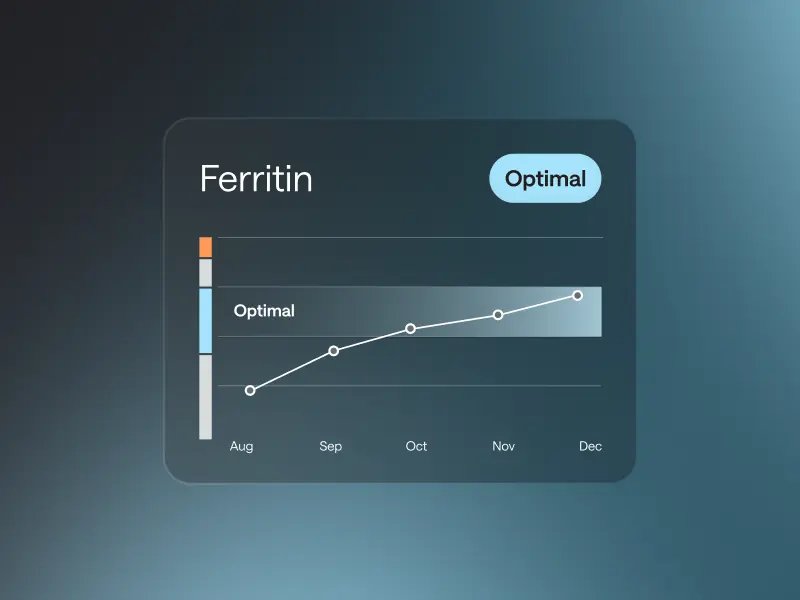
Quarterly testing offers a broad view but does not capture how these changes unfold. Monthly testing offers more precise slope estimation, helping individuals determine whether a trend is stable, improving, plateauing, or drifting in an unexpected direction. This high-resolution information is especially valuable when someone is making active changes and wants to understand their physiologic response.
Monthly Testing Is Particularly Helpful in Certain Clinical and Lifestyle Contexts
While routine quarterly or annual testing is sufficient for many stable patients, there are scenarios where more frequent sampling is scientifically justified, even if not mandated by guidelines.
1. Individuals on TRT or HRT
Hormone levels fluctuate across a dosing interval. Monthly data early in therapy or during lifestyle changes can help:
interpret trough versus peak effects
assess SHBG shifts
understand lipid changes that accompany androgen or estrogen therapy
align laboratory timing with dosing consistency
Once stable, testing can transition to less frequent intervals.
2. Individuals using GLP-1 agonists or undergoing active weight loss
Trials show month-scale improvements in lipids, CRP, and metabolic markers. Monthly sampling reveals:
early responders
rate of metabolic improvement
whether markers plateau or reverse
whether changes align with expected physiologic patterns
3. Individuals making intensive lifestyle changes
Diet, exercise, sleep, stress reduction, and alcohol changes often produce measurable effects within 4 to 8 weeks. Monthly testing provides actionable feedback that reinforces beneficial behaviors and identifies ineffective strategies early.
4. Individuals with historically high biomarker variability
Research on visit-to-visit variability in lipids shows that greater fluctuation is associated with higher cardiovascular risk. People with intrinsically variable numbers may benefit from more frequent sampling to separate noise from meaningful signal.
5. Individuals training for a sporting event or undergoing structured athletic training
Training for a race, competition, or performance goal introduces deliberate physiologic stress that can shift biomarkers over relatively short timeframes. Monthly testing during a training block can help:
differentiate adaptive changes from maladaptive stress, such as distinguishing normal training-related inflammation from persistently elevated CRP
track lipid responses to increased training volume or intensity, including shifts in triglycerides, HDL, LDL, and ApoB that can occur with changes in energy balance and fuel utilization
monitor thyroid markers during high training load or caloric restriction, since TSH and free T3 can shift in response to sustained energy deficit or overreaching
observe sex-hormone dynamics during intense training, particularly in men where testosterone and SHBG may fluctuate with training stress, recovery quality, and body composition changes
assess recovery and readiness trends over time, rather than relying on a single snapshot that may reflect an acute training week rather than overall adaptation
Because training adaptations often unfold over weeks rather than months, monthly sampling allows athletes to see whether biomarkers are stabilizing, drifting, or signaling inadequate recovery. Once a training cycle is complete and physiology has returned to baseline, testing frequency can be reduced.
Monthly Testing Enhances AI Interpretation and Pattern Recognition
AI models rely on repeated observations. With only annual or quarterly measurements, AI can describe static values but cannot characterize patterns, rates of change, or stability.
With monthly data, AI can:
distinguish short-term fluctuations from emerging trends
quantify each user’s biological variability
identify subtle directional changes
improve prediction of future trajectories
align insights with individual physiology rather than population averages
This makes longitudinal interpretation significantly more accurate than when working with sparse or widely spaced data points.
Monthly Testing Is Not a Medical Requirement, But It Is a Tool for Higher-Resolution Insight
No current clinical guideline states that monthly testing is necessary for safety or routine disease management. Likewise, no guideline prohibits more frequent testing when the goal is self-understanding, behavioral optimization, or trend detection. Traditional medical intervals are designed for risk management, diagnosis, and medication monitoring, not for high-resolution personal tracking. Clinicians often acknowledge that many biomarkers move over one to three months. Monthly testing simply aligns with that physiological reality.
Monthly testing complements, rather than conflicts with, medical guidance by:
providing more data to help contextualize wellness decisions
uncovering short-term responses to therapy or lifestyle changes
supporting behavior change with timely feedback
enabling more precise trend monitoring over time
Monthly testing is not meant to redefine clinical guidelines. It is designed to give individuals deeper insight into their unique biology. Many biomarkers change meaningfully over a 4 to 8 week window, and month-to-month measurements can reveal patterns and responses that annual or quarterly testing cannot capture. For people on hormonal therapies, GLP-1 medications, or engaged in active lifestyle change, monthly sampling provides clarity, context, and a more accurate picture of how their physiology is evolving.
TL;DR Rythm’s monthly cadence offers a scientifically grounded way to transform bloodwork from a once-a-year snapshot into a dynamic portrait of health.
References
Nazir DJ, Roberts RS, Hill SA, McQueen MJ. Monthly intra-individual variation in lipids over a one-year period in normal subjects. Clinical Biochemistry. 1999;32(5):381–389.
Wasenius AWA, Stugaard M, Otterstad JE, et al. Diurnal and monthly variability of serum lipids, lipoproteins, and apolipoproteins in healthy subjects. Scandinavian Journal of Clinical and Laboratory Investigation. 1990;50(6):635–642.
Fatica EM, Jenkins SM, Scott RJ, et al. Short- and long-term biological variability of small dense LDL, HDL3, and triglyceride-rich lipoprotein cholesterol. Journal of Applied Laboratory Medicine. 2022;7(5):1047–1061.
European Federation of Clinical Chemistry and Laboratory Medicine (EFLM). Biological Variation Database.