


How Rythm Runs a Full Clinical Panel With So Little Blood
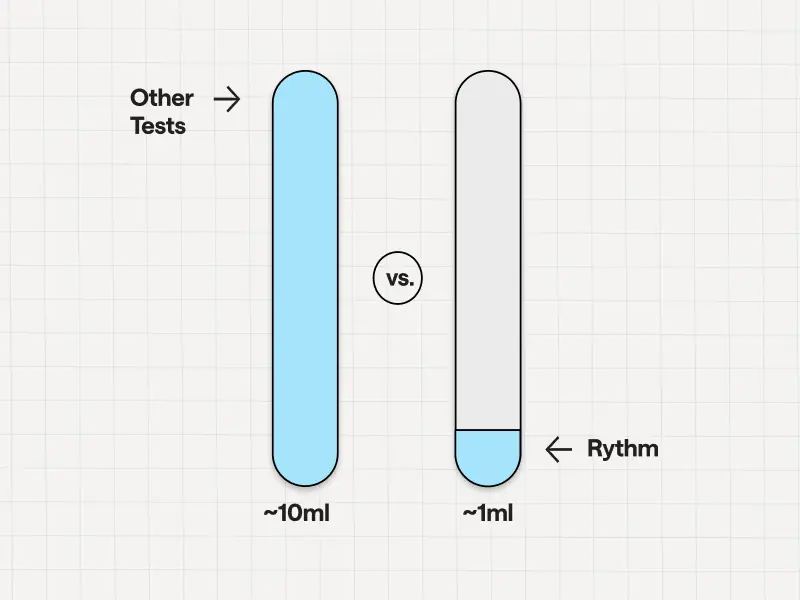
For most people, the experience of having blood drawn still conjures the image of large vacuum tubes filling one after another in a phlebotomy chair. It is surprising to learn that modern clinical analyzers rarely need more than a few microliters to a couple hundred microliters of plasma or serum to run a test. The volume collected in a traditional venipuncture is far greater than the volume actually analyzed. Rythm Health takes advantage of this scientific reality, along with our integrated laboratory workflow, to dramatically reduce the amount of blood required for high-quality testing.
Why Rythm Needs Less Blood
Rythm uses a collection process that is deliberately engineered for efficiency. Because we validate our assays, instruments, and workflows specifically for the volume collected with the Tasso+ device, we do not rely on standard vacuum tubes that were designed decades ago around high-volume venipuncture. Modern FDA-regulated chemistry analyzers use extremely small aliquots for measurement. Many assays require less than 100 microliters of plasma. Even if a test requires repeated runs or internal quality checks, the total volume necessary remains minimal.
This means that when the entire workflow is optimized, the amount of blood required for a full biomarker panel is far smaller than most people expect. A single high-yield Tasso+ collection into a lithium heparin tube can provide enough plasma for more than a dozen measurements, including lipids, hormones, vitamin D, inflammatory markers, and thyroid function tests. Because we run our own laboratory, we can validate every assay in-house for the exact sample volumes produced by our at-home collection method. This removes the inefficiencies built into traditional phlebotomy workflows and allows us to run a clinically rigorous panel with minimal blood loss for the user.
Why Traditional Laboratories Draw So Much Blood
Large draw volumes are not required for scientific accuracy. They are a consequence of how traditional laboratories and phlebotomy workflows evolved. Several factors explain the high-volume approach used in typical clinical settings:
1. Standardized vacuum tubes are built for workflow convenience, not volume efficiency
Most blood collection tubes hold between 5 and 7 milliliters. They are designed around the mechanical requirements of venipuncture and the convenience of handling a single standardized tube type. Engineers did not design these tubes around the true analytical volume needed for each test.
2. Phlebotomy labs over-collect to allow for repeats and contingencies
If an instrument flags a value, or if a test requires a reflex assay, the laboratory wants spare sample volume already present. Drawing a full tube ensures redundancy, even if most of it is never used. When Rythm needs to repeat a run, we typically have sufficient volume remaining to rerun; however, in rare cases, we will reach out for a new sample from the user.
3. Workflow dependence on multiple tubes increases total collected volume
A typical adult panel drawn in a clinical setting often uses several tubes for various additives. Even though only small aliquots are analyzed, the amount collected can reach 20 to 30 milliliters. The majority of that blood is discarded after testing.
4. Historical workflows persist because they are operationally simple
Traditional laboratory systems, staffing models, and automation pipelines are optimized around high-volume venipuncture, which means the practice continues even if smaller volumes would work analytically.
TL;DR: Traditional blood draws prioritize throughput and operational consistency rather than minimizing the amount of blood taken from each patient.
How Rythm Delivers Clinical-Grade Accuracy Using At-Home Collection
The accuracy of laboratory testing depends on the analytical method and the integrity of the sample. It does not depend on how much blood is collected. When the laboratory, collection method, anticoagulant, and workflow are validated together, at-home capillary collection can achieve the same clinical accuracy as traditional venipuncture.
All assays are performed on FDA-approved instrumentation designed for clinical diagnostics. These analyzers already operate on very small sample volumes, which is why reducing the draw volume does not compromise accuracy. Lithium heparin is widely used in hospital chemistry laboratories. It provides stable plasma for lipids, thyroid markers, inflammatory indicators, sex hormones, vitamin D, and apolipoprotein measurements.
Our assays are validated specifically for small-volume capillary samples. This is the critical distinction. Because Rythm owns and operates its laboratory, we validate each test for the precise conditions under which the sample is collected. This is something traditional laboratories do not do, because their workflow is built for venous tubes. Modern analyzers require microliters, not milliliters. Even when laboratories receive large venous tubes, the analyzer only uses a fraction of the collected volume. With careful method validation, there is no scientific requirement for high-volume collection.
Our integrated chain-of-custody ensures specimen integrity. Your sample is scanned at every stage, from kit fulfillment to laboratory receipt. This level of control minimizes pre-analytical variation, which is one of the largest determinants of accuracy in clinical testing.
Clinical studies have repeatedly shown equivalence between capillary and venous samples when properly validated. For many chemistry, hormone, and immunologic markers, capillary plasma provides results comparable to venous specimens when the collection and processing workflow is validated. Rythm applies this evidence base to ensure clinical-grade accuracy.
TL;DR: By owning the entire pipeline, from at-home collection to laboratory analysis, Rythm is able to use the minimal amount of blood analyzers actually require, while still providing accurate, clinical-quality results.